Your organisation already holds most of the knowledge its people need. It sits in standard operating procedures, policies, manuals and slide decks. The BlitzLIS AI course generator turns those documents into structured courses, while keeping your experts in charge of what ships.
What you can start from
Describe the course you want in a prompt, or upload source material: PDF, DOCX and PPTX files, URLs, SOPs, policies, manuals and transcripts.
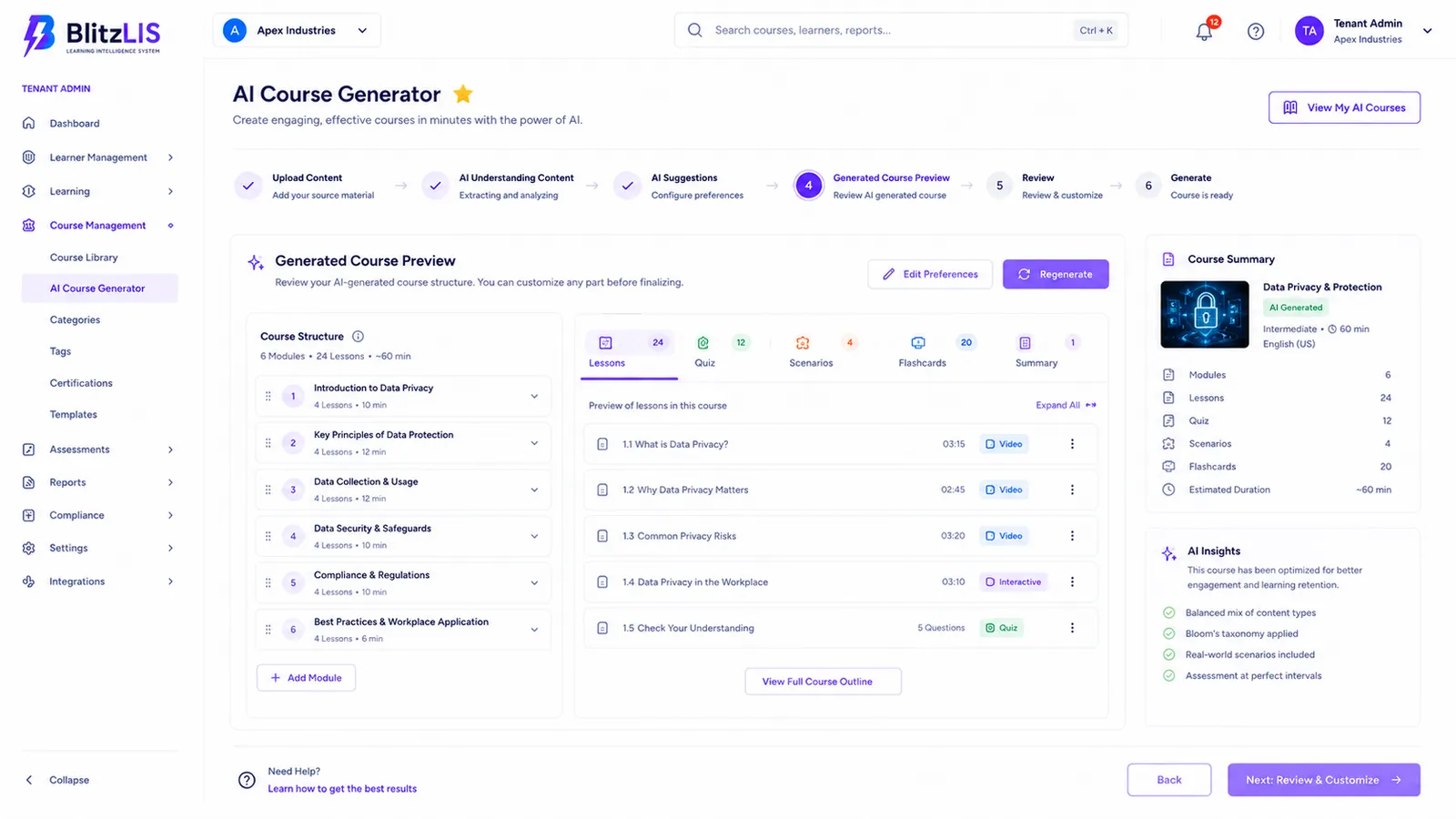
The six steps
- Prompt and upload. Tell BlitzLIS what the course is for and add your sources.
- Extract objectives. The learning objectives are drawn from your material.
- Generate the outline. Modules and lessons are organised into a structure you can change.
- Draft lessons and quizzes. Lessons, examples and assessment questions are written for each section.
- Human edit and review. Authors refine the draft in the block editor, and reviewers approve it.
- Publish and assign. The approved course goes live and is assigned to the right audiences.
Assessments built in
Quizzes can use multiple choice, multiple response, true/false, fill in the blank, matching, ordering, essay, short answer and file upload questions, with question pools, randomisation and AI question generation.
Governance at every step
- Source citations are preserved and prompt history is logged.
- Every AI output is editable before publishing.
- Nothing reaches learners without human approval.
- BlitzLIS does not train AI on client data.
See it with one of your own documents: book a demo, or explore AI Studio.